Principled AI Leadership: Less Noise, Greater ClarityBy Steve Behrendt, PhD and Martin Castro, PhD, Germantown School District The technology continues to evolve at a remarkable pace, expanding what educators can create, automate, and learn. The question is not simply which AI tool to choose, but how to apply it intentionally. Useful AI requires more than promptcraft. Our Solution is to establish fence posts through trusted sources, guiding principles, clear priorities, firm boundaries, and human oversight. Together, these elements form Our Framework: an AI constitution designed to keep AI aligned with our purpose, audience, and context. AI is non-deterministic - The same prompt can produce different answers. As we wrote in The Case for Constraints, using AI is like rolling weighted dice: some outcomes are more likely than others, but the result is never completely certain. Promptcraft helped, but it is not enough - Early guidance emphasized “garbage in, garbage out” and encouraged users to write better prompts. Strong prompts improve individual responses, but they do not establish the lasting context, priorities, sources, boundaries, and voice needed across interactions. Without parameters, AI can drift. Even as models improve, they can make unsupported assumptions, reflect bias, miss important context, or confidently present inaccurate information. AI also tends to agree with the user, reinforcing existing assumptions and creating an echo chamber when ideas are not challenged or grounded in evidence. Without guidance beyond the prompt, AI can add noise and clutter instead of providing the clarity, precision, and productive challenge leaders need. It risks becoming another problem to manage rather than a tool that deepens understanding and supports the work. Go deeper: Read our AWSA article, The Case for Constraints: Why AI Needs a Bounded Universe in Education, to explore why probabilistic AI needs clear guardrails and human oversight. The Solution: From Fence Posts to a Constitution As the technology evolved, so did our approach. We realized that individual fence posts were only the beginning. AI needed a constitution: a consistent set of instructions, sources, priorities, and expectations built around a leader’s specific context and work. This moved us beyond writing better prompts toward creating an AI framework that remains principled across tasks, contexts, and over time. Go deeper: Explore the fence posts that shaped our evolving framework in Beyond the Basics: Advanced Use of ChatGPT, presented at SLATE in 2025. The Framework:
Go deeper: See how we introduced this framework at the National School Leaders Conference in A Constitutional AI. Ideas to Action: Depending on participant interests, examples may include creating a staff podcast, building a website, developing a strategic-planning dashboard, designing professional learning, strengthening daily communication, or creating an AI thought partner to accelerate your learning, ground it in your organization’s priorities, and maximize resources. The tools and products may vary, but the framework for producing precise, accurate, and accelerated work remains consistent. |
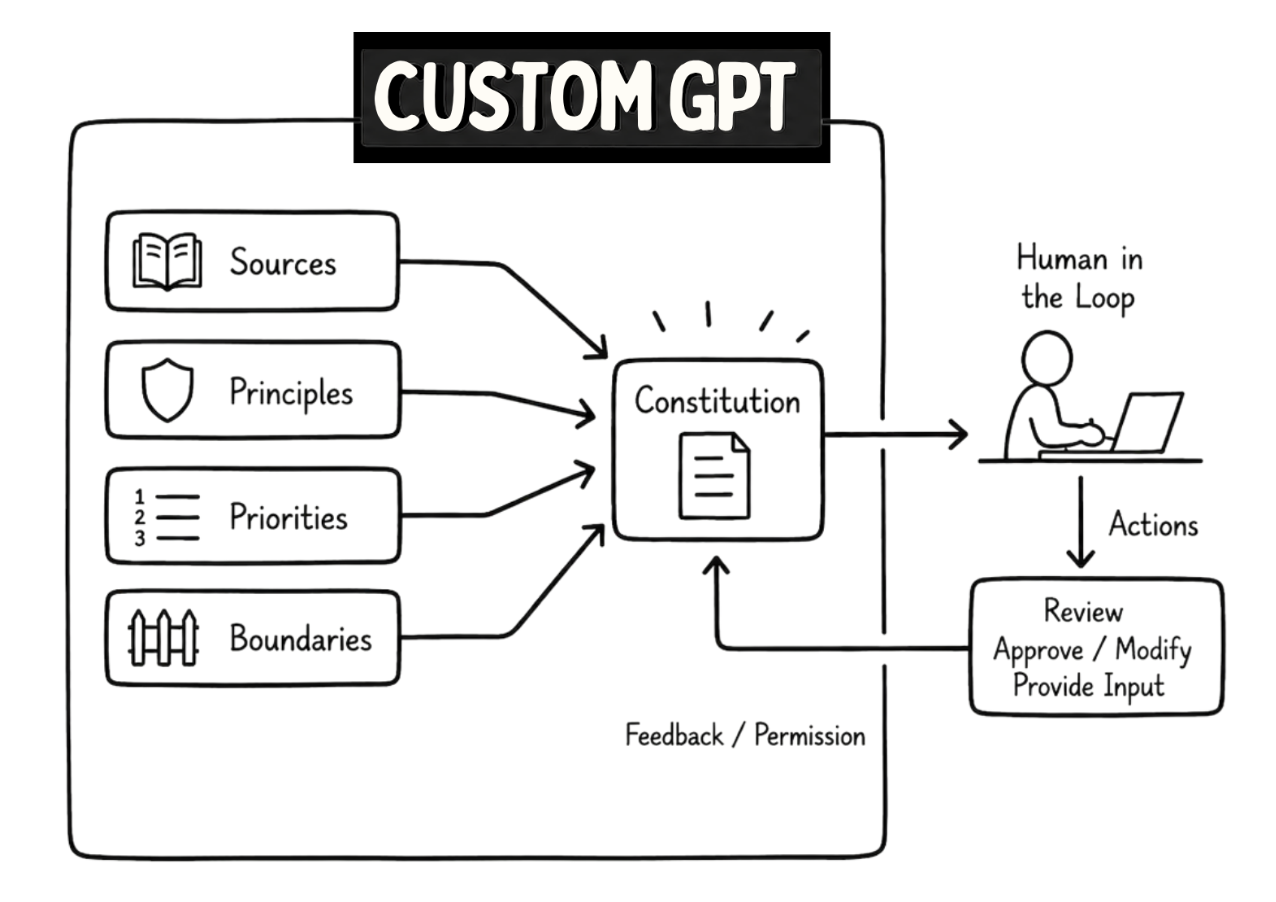 Even with these parameters in place, we insist that a human remain in the loop. Without ongoing oversight, AI can drift from its intended purpose, audience, or context. AI can support thinking and accelerate the work, but the leader remains responsible for reviewing, refining, and redirecting its output. AI generates possibilities; human judgment determines what is accurate, appropriate, and ready to use.